Release time : 2026-10-14 Source :Organizing Committee
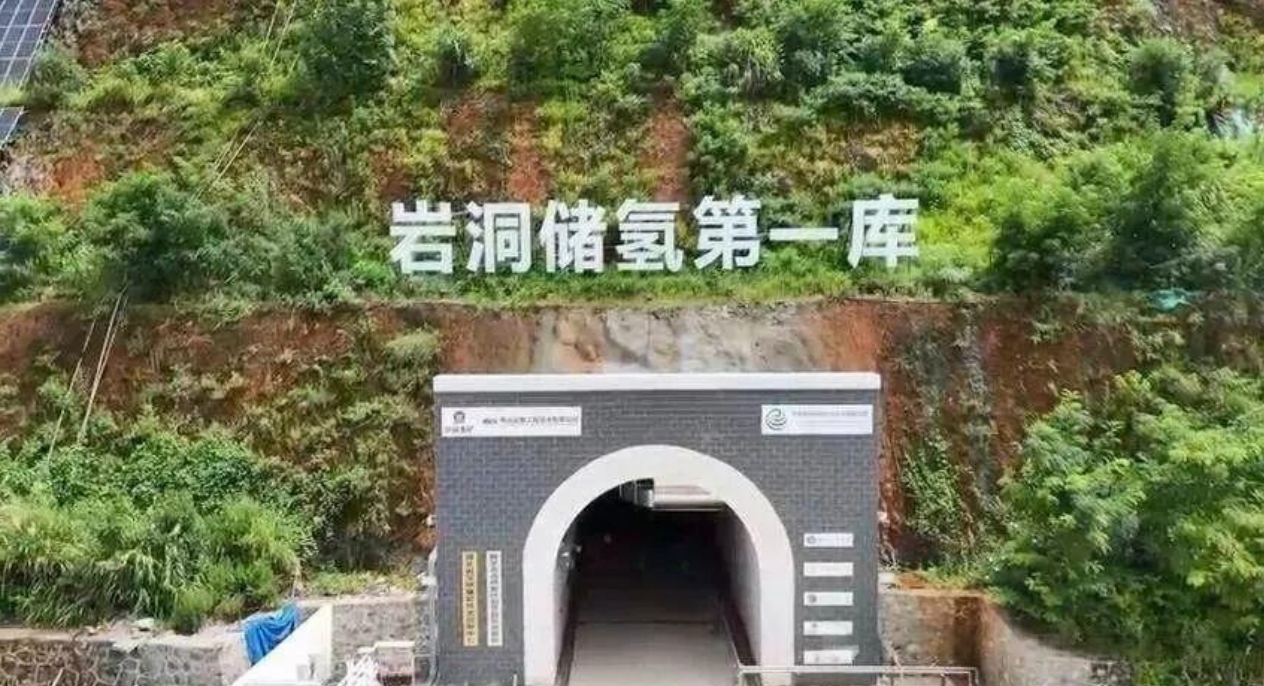
The national key R&D program demonstration project for rock-cavern hydrogen-storage has successfully finished hydrogen pressurisation testing, with hydrogen injected into a disused mountain mine cavity in Songwan Village, Jinhu Sub-district, Daye City. All operational parameters met targets and remained stable. The milestone marks a “zero-to-one” breakthrough for China’s first pilot-scale rock-cavern hydrogen-storage verification platform.
“Hydrogen production is challenging, yet hydrogen storage poses even greater difficulties,” said Xie Liang, Deputy Chief Engineer at MCC Wukan Engineering Design Institute, who took part in the full-cycle R&D and construction of the project. Hydrogen molecules are small and prone to leakage. Hydrogen-induced embrittlement can trigger micro-cracks or even fractures in metals under mechanical stress. Conventional above-ground steel spherical storage tanks require heavy, thick-walled construction to withstand high pressure, resulting in high capital costs, limited storage capacity and large land footprints. These drawbacks become more pronounced as project scale expands.
“Given the constraints of surface-mounted tanks, we adopted an alternative approach: leveraging mountain rock mass to bear pressure, provide sealing and ensure safety — functions that would otherwise consume massive steel and land resources,” Xie Liang explained. The dense, thick surrounding rock formation of the cavern withstands high pressure and prevents hydrogen escape. An anti-hydrogen-embrittlement sealing liner and special-grade concrete form multi-layer protective barriers inside the cavern. The rock mass bears mechanical pressure while the steel liner undertakes sealing duties. Built deep inside mountains, the cavern-based storage delivers large-capacity hydrogen containment without occupying surface land and offers enhanced inherent safety.
Turning this concept into reality presented substantial technical hurdles, with no prior comparable references globally. Abandoned mine tunnels left by long-term mining activities in Daye offered natural candidate storage sites, transforming former ecological liabilities into valuable energy assets. Led by the academic team of Academician Yang Chunhe from Wuhan Institute of Rock and Soil Mechanics, Chinese Academy of Sciences, and supported by sealing-material research led by National Distinguished Engineer Ding Wenhong, the project was developed and invested in by MCC Wukan, under the auspices of Hubei Deep-Underground Energy Storage Technology Innovation Center.
The research team tackled bottlenecks covering fundamental theories, hydrogen-resistant materials, construction techniques and intelligent monitoring systems, delivering a horizontal-tunnel-type rock-cavern hydrogen-storage facility with a single-cavity capacity of 50 000 standard cubic metres of hydrogen. Its single-unit storage scale and full-supply-chain integration rank among the world’s leading levels. Recognised as a national first-of-its-class major energy-sector technical equipment, the site is hailed as “China’s No.1 Rock-Cavern Hydrogen-Storage Depot”.
Successful completion of the hydrogen pressurisation test fills a critical gap for large-scale hydrogen storage. Surplus green power from photovoltaic generation can be converted into hydrogen and stored underground, then released when required. The solution mitigates renewable-energy output volatility and resolves supply-demand mismatches, enabling a complete closed-loop for hydrogen covering production, storage, transportation, refuelling and end-use applications.
“We have completed hydrogen injection and validation for this pilot facility, laying groundwork for replicating this technology in large-scale commercial projects,” Xie Liang commented. The project has entered the long-term stability and sealing-performance verification phase. Partners will jointly develop large-scale composite-structure simulation test rigs to pave the way for the engineering realisation and industrialisation of large-capacity rock-cavern hydrogen storage.
Exhibitor/Conference Consultation
Contact: Ms. Becky CHEN
Tel: +86 15910580218
Email: becky@cntigerexpo.com
Exhibitor Consultation
Contact: Mr. Lito HU
Tel: +86 13601321637
Email: lito.hu@cntigerexpo.com
Exhibitor Consultation & Media Cooperation
Contact: Ms. Yasmin ZHENG
Tel: +86 13621183385
Email: zhengyaxin@cntigerexpo.com