Release time : 2026-11-13 Source :Organizing Committee
Jiaxing, Zhejiang Province, launched a demonstration service for hydrogen-powered shared two-wheelers on November 12, marking a new application of hydrogen technology in urban short-distance mobility.
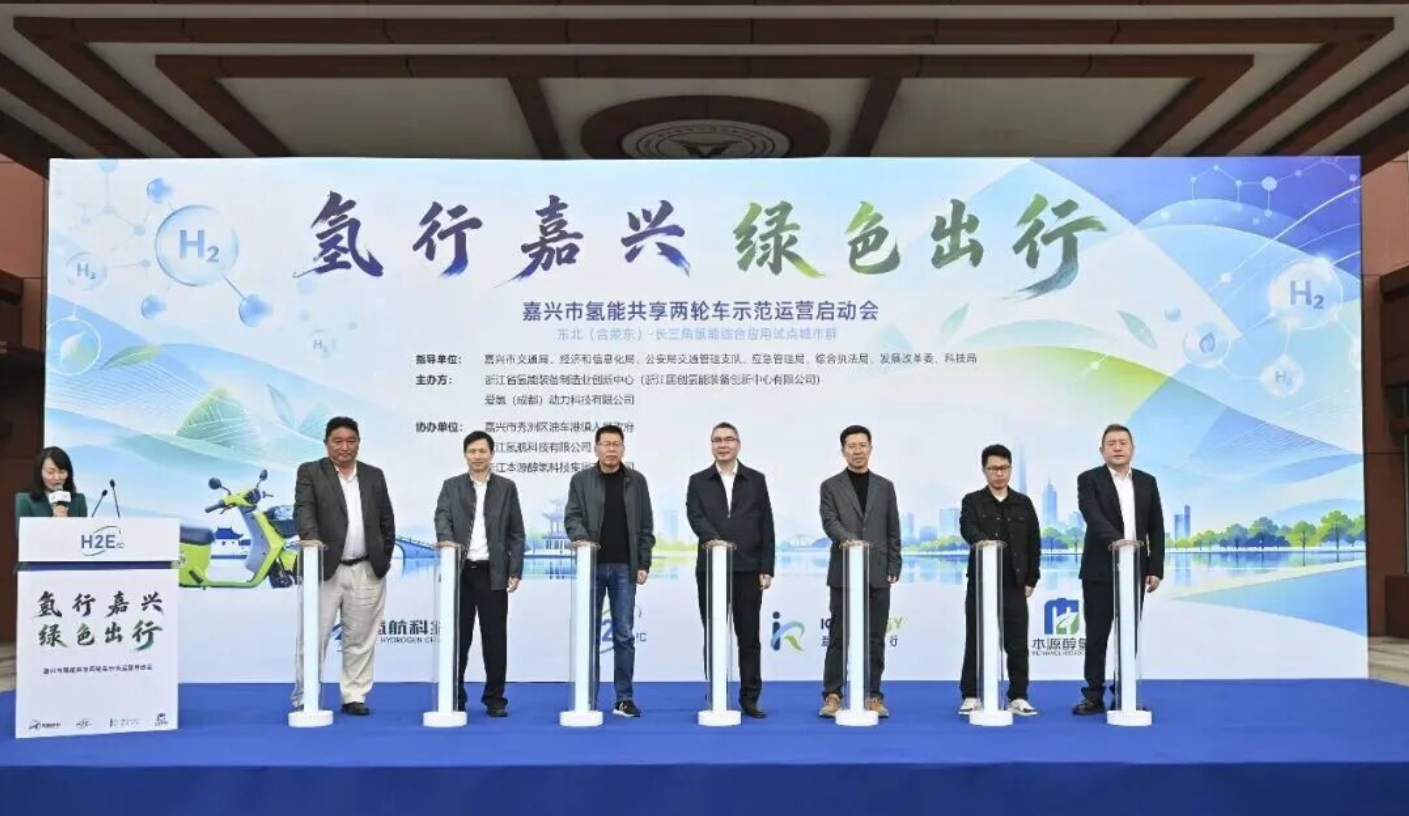
The project was organised by the Zhejiang Hydrogen Energy Equipment Manufacturing Innovation Center, with participation from Aiqing (Chengdu) Power Technology Co., Ltd., Zhejiang Hydrogen Craft Corporation Ltd. and other partners. The launch ceremony took place at the Yangtze Delta Region Institute of Tsinghua University, Zhejiang.
The initiative comes as China steps up efforts to expand hydrogen applications across multiple sectors. In March 2026, the Ministry of Industry and Information Technology, the Ministry of Finance and the National Development and Reform Commission jointly issued a notice identifying two-wheelers as one of the innovative application scenarios for hydrogen .
In October, the three authorities approved five city-cluster pilot programmes for comprehensive hydrogen applications, each running for four years. One of the selected clusters links Northeast China, including eastern Inner Mongolia, with the Yangtze River Delta.
As a city in Zhejiang Province and part of the Yangtze River Delta, Jiaxing is working to integrate hydrogen technologies into a broader range of applications. The shared two-wheeler pilot represents a further step in expanding hydrogen use in the transport sector.
Officials from the Jiaxing Highway and Transportation Administration Center, the Jiaxing Municipal Bureau of Economic and Information Technology and the Traffic Management Detachment of the Jiaxing Municipal Public Security Bureau attended the launch, alongside representatives of the partner companies.
The innovation center outlined the project, while company representatives introduced the cooperation arrangements, vehicle products and technical applications. Guests also took test rides on the hydrogen-powered shared two-wheelers.
The vehicles have a range of approximately 70 km between hydrogen-cylinder swaps. An onboard fuel cell converts hydrogen into electricity to power the vehicle.
The vehicles use a cylinder-swapping system for refuelling. When the hydrogen supply runs out, users can restore the vehicle's range by replacing the storage cylinder, avoiding lengthy refuelling stops. The system also allows operators to manage and dispatch the fleet centrally.
Designed for short daily commutes and trips within industrial parks, the vehicles offer an alternative to conventional fuel-powered two-wheelers without producing the associated tailpipe pollutants during operation.
Exhibitor/Conference Consultation
Contact: Ms. Becky CHEN
Tel: +86 15910580218
Email: becky@cntigerexpo.com
Exhibitor Consultation
Contact: Mr. Lito HU
Tel: +86 13601321637
Email: lito.hu@cntigerexpo.com
Exhibitor Consultation & Media Cooperation
Contact: Ms. Yasmin ZHENG
Tel: +86 13621183385
Email: zhengyaxin@cntigerexpo.com